
Samantha Keeley Smith
I was looking for inspiration for the (re-)design of my website. I searched for things like “best artist portfolio websites” and “examples artist website” and variations on that. That search turned up a lot of lists of artists’ website, some I found interesting, some I found slick, some uninspiring, occasioanally the artist and their work would leap out beyond the website design and I would be forced to pay attention. That in part told me the website design worked, for that portfolio purpose. It also exposed me to artists I might not find from other sources.
Samantha Keeley Smith was one artist who stood out. I loved the colors, the flow, the feeling in her paintings. The website design stood aside, allowing the work to show through.
This is “Forget Fate”:
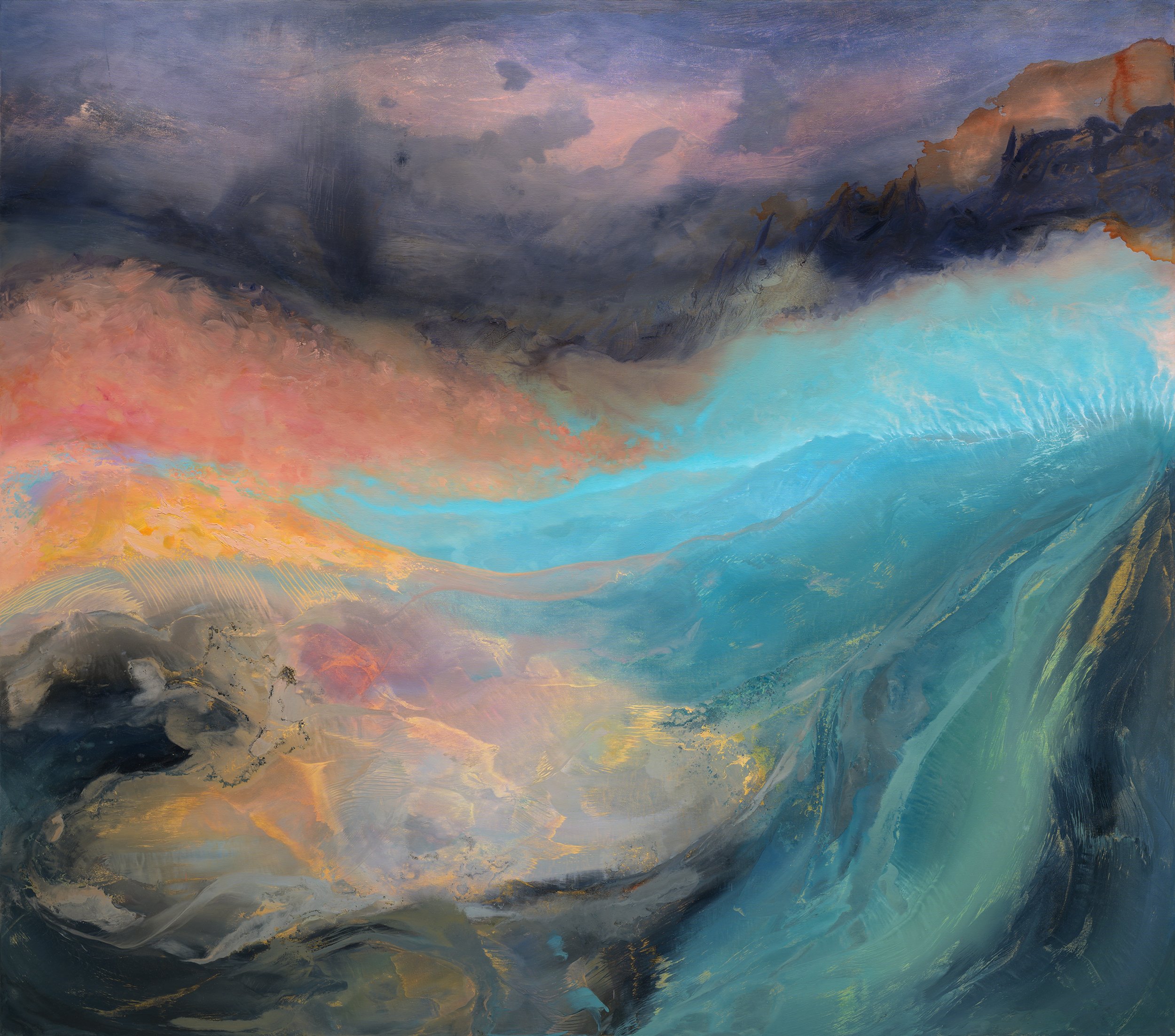
The first website rework I did followed some of her site design elements - a two-column on desktop cascading to a single column on mobile screens. A carousel on desktop with details of title and size, medium and substrate on a box changing with each new painting, following along, all of that cascading down to a scrolling list on mobile. Simple fonts, clear images as large as possible. I changed the design for my site again after that because I found a different design, a single column, was more adaptable and stayed simpler for how I was coding it, and for what I want to do with it. I was using HUGO, a go language static site generator, to assemble a static website with minimal javascript and css. I wanted to integrate into a Shopify Storefront as seamlessly as possible. A single column design with menu at the top worked better for me for both purposes.
But the paintings Samantha Keeley Smith makes, the images, stuck and clarified the direction of my art in profound ways. I felt that inner wish, “I want to paint something like that…”
I was taught oil painting in a traditional manner. I glazed color over a monochrome underpainting, gradually building up profound transparent color over many layers. All in oil paints, with linseed oil and turpentine and odorless mineral spirits. Solvents to thin, to wash in transparent color, to clean brushes. A rag in one hand, brushes in the other and an open container of solvent on the palette table. I followed along behind Impressionist masters, also in oils, also with OMS and turpentine and with never enough ventilation.
When I began painting again in 2003, I began with oils. I moved to acrylics in 2005 because I was enamoured of Pop artists like Tom Wesselmann (who actually DID paint with oils, even in collage and pop art works, but somehow I missed that…) and Roy Lichtenstein (who used acrylics), and I wanted that quick hot color and texture and I did not want to work with solvents any longer. Initially I found acrylic paints so very dull in appeartance I almost dropped them for water-based oils or some other kind of painting substance, or for painting in a respirator. And then…
I asked the question of Google “Why are oil paints so luminous”, and “What causes acrylic artist paints to be dull”. Somewhere in my research I found that airbrush, which is often done in acrylic paint, kept the luminance because it placed paint on the substrate in spheres, which allowed the light to bounce around the edges and keep the luminance straight acrylics lost. I found I could keep the luminance, the bounce of light, by underpainting in pure primary and secondary color using airbrush, then paint acrylic artist paints on top of that. That worked for me for quite awhile.
In Samantha Keeley Smith’s paintings I found not just color, brilliant luminous ecstatic color, but also edges and drips and wet-into-wet, dry brush across texture, stuff I had lost in acrylics. She paints in oils. Acrylics can do some of this but never with the facility, the flow, that oil paints allow. Oils have a depth and a luminance that I fell back in love with in these paintings, and which I felt I had to find a way to bring back into my own work.
I’m afraid of solvents, of sacrificing my braincells for art (anymore, anyway), and I’m not willing to wear a respirator all the time either. In researching whether it was possible to skip the odorless mineral spirits and the more caustic acetone, paint thinner, etc, I found solvent-free methods. I’ll be using those, adapting to what I want the paint to do.
I’m still paging through samanthakeeleysmith.com in awe. I’m profoundly grateful for the inspiration.
I’ll link to one image, there are many, many others.
This is “Buoy”:

Paintings like these makes me very happy. They lift any fog from a day. I definitely want to paint something as colorful and flowing as these. They just look like so much of a joy to make. I hope they are so to the artist.
—spence