
Alla Prima II (Richard Schmid)
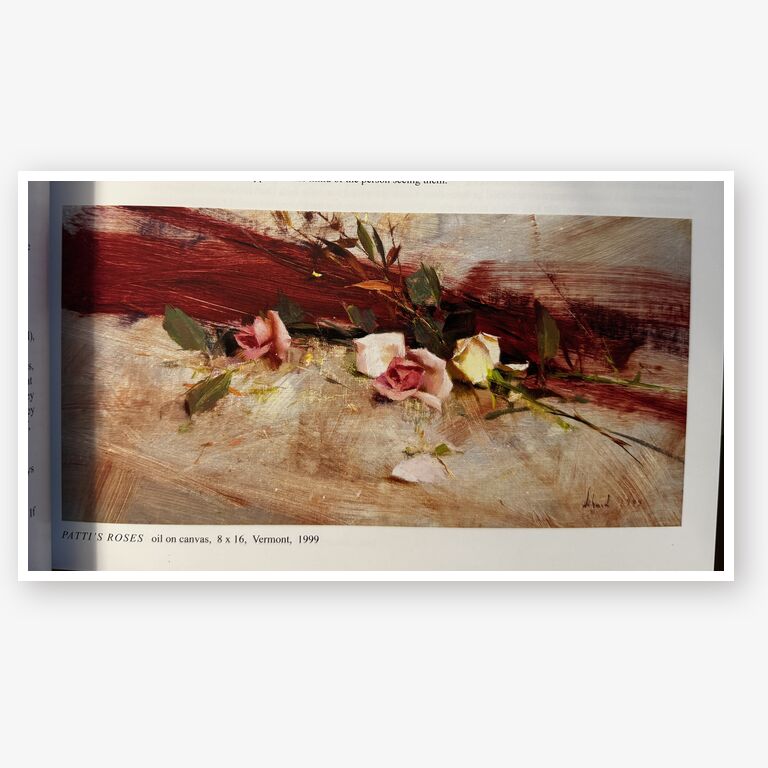
The photo above I took of one of Richard Schmid’s still life paintings in his book Alla Prima II. The crispness of the paint around the petals of the rose contrasted with the almost-abstract foreground and background captured my eyes. It is seriously good painting, the kind of gestural confidence I love in ym work when I manage to pull it off.
My painting studies at UCLA and later mentoring was all in oils. I loved that media, and after 17 years working with acrylics and then a year working through watercolor, learning it from scratch, I want to work in oils again. I have some paintings in mind I want to do that I think will work better in oils. I surveyed what writings about painting in oils have been published in the last decade and a half. I found Richard Schmid’s book. It’s breathtakingly expensive, but worth it, I think. The subtitle Everything I Know about Painting - and More is exactly right, and this is a master painter.
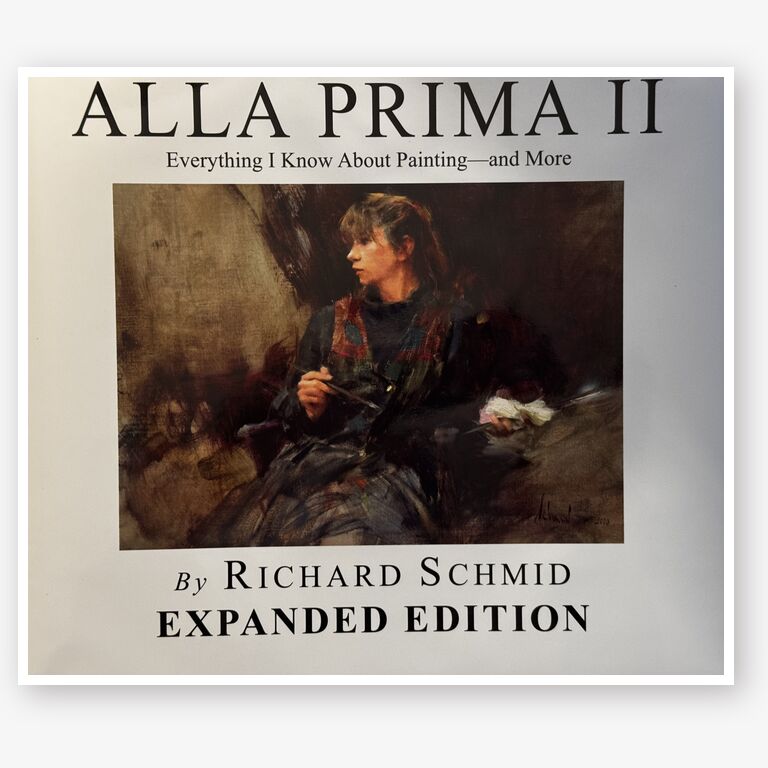
I read it cover to cover in about 5 days.
It is some of the most understandable writing about the process of painting I’ve experienced, ever. It’s clear, it can be followed and I can see from his descriptions of what he considers when painting how he came to create those roses.
The book brought up values, dark to lights, which I knew and paid attention to in painting, and then edges, which I’ve used instinctively but not on purpose. I can’t wait to try this consciously and intentionally in crafting the focus of a painting.
Richard also speaks of how he works through direct painting and outlines several beginning methods. The one I found most exciting is to place the obvious pieces, the ones you have certainty you can place correctly, first, then align the rest to the accurate bits. Simple, yes? Yep. Also truly profound. It minimizes the concentration on how to get things in the right places by drawing and lets the focus be on shape and value, hue, and edge instead. Again, this is how I find I work when things are going well in a painting, but this is what I fall into, not the craft I intentionally create.
The color panels I’m working through come from his book. I’ve done smaller samples, color wheels, with new paints. These twelve panels are way more complete. The jewel qualities of Alizarin Crimson, the earth tones, the greys, the incredible variety of possible skin tones and hues, all of this is hit or miss when mixing colors to get to a color without this basic experience of a broad swath of what a set of colors on a palette is capable of.
I’ve done 9 panels so far. It did not take the two weeks, it takes about two hours to work through each panel, and about 5 rags each. I’ve found I can fold white in for each value pretty quickly once the top mix is done, and use a single brush wiped with a rag, no dipping to clean required. I’m not following any set proportion of mixing, I wouldn’t in painting anyway, so I’m working through the values judging each one along the way.
Once these are dry, I think I’ll give them a coat of varnish. I’m not sure if I will hang them on the wall, or assemble them into a color set. I’ve drilled a 1/4" hole in the top left(vertical) / bottom left (horizontal) corner. I could tie the panels together with parachute cord, like a large color swatch set. The hole, though, is to allow hanging them from the rafters to dry. The pure pigments are not drying fast, and I used a flake white which is also slightly slower drying. I expect to have to hang them for several weeks to a month to be safely dried. Varnishing in 4 to 6 months. This isn’t canvas, it’s a single layer, it doesn’t need to be archival. This time should be enough.
—spence